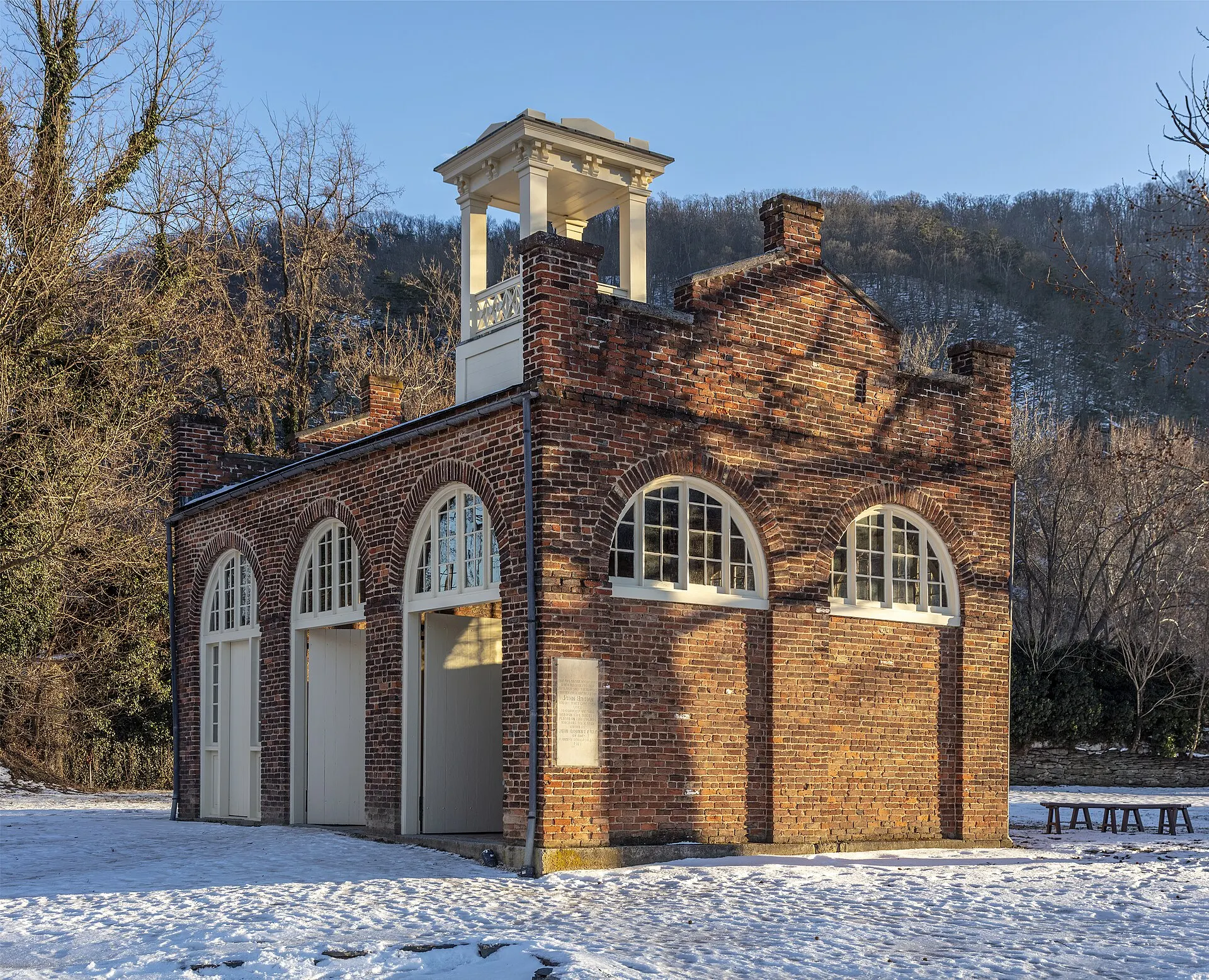
John Brown's Fort is a small brick building with a cupola and arched doors that has traveled farther than most visitors to Harpers Ferry. It was built as the U.S. Armory's fire engine house, became John Brown's last stronghold in 1859, and was then shipped to Chicago, rebuilt on a farm, moved to a college campus, and finally brought back to Lower Town. This guide covers what the building was, the siege, each of its four moves, and how to visit it today. For the raid itself, hour by hour, see our John Brown's raid guide.
Know before you go
| What it is | The U.S. Armory's fire engine and guard house, built 1848 |
| Where | Lower Town, the last building on the right as you walk along Shenandoah Street from the shuttle stop — NPS |
| Status (Nov 2026) | Open — NPS conditions |
| Hours | Open during park hours; Lower Town buildings are listed as 9am–5pm daily — NPS hours |
| Cost | No separate ticket; park entrance fee of $20 per vehicle, $15 per motorcycle or $10 per person, valid 3 days, no cash — fees & parking guide |
| Access | Loose gravel path to the doors; middle doorway has a threshold of about 3 inches |
| Pets | Allowed on the grounds on a 6-ft leash, not inside the building |
| Distance from original site | About 150 feet east |
What is John Brown's Fort?
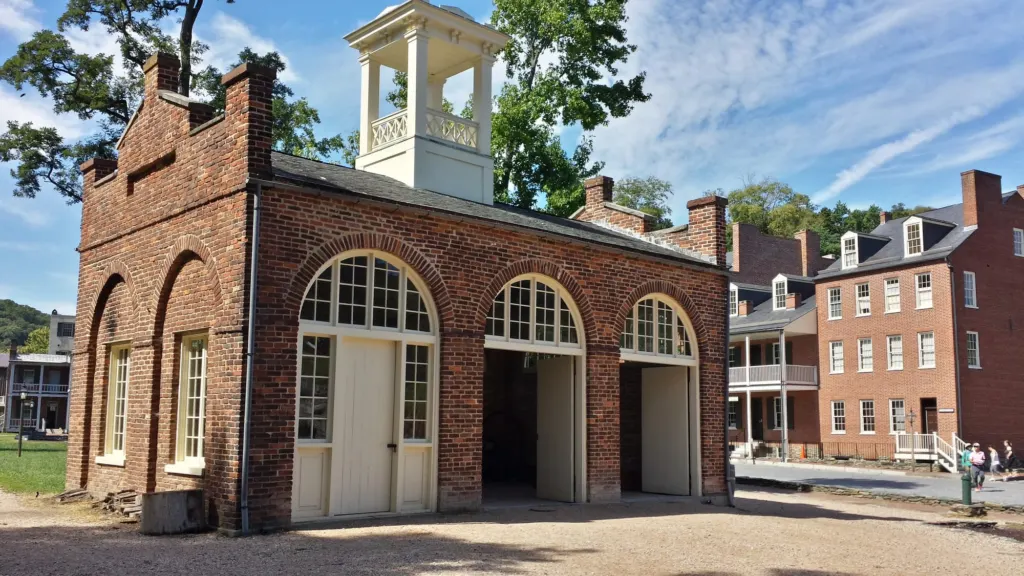
John Brown's Fort is the fire engine and guard house of the old U.S. Armory at Harpers Ferry, built in 1848. A June 30, 1848 armory report quoted by the NPS describes it as "An engine and guard-house, 35½ x 24 feet, one story brick." It held the armory's fire engines and its watchmen.
The building owes its name to October 1859, when the abolitionist John Brown and his last remaining men barricaded themselves inside during the final hours of their raid. It is also the only armory building that survived the Civil War. U.S. soldiers set fire to the armory and arsenal on April 18, 1861, and the rest of the works were later destroyed; the engine house was left standing, though soldiers and travelers stripped it for souvenirs. Read more about the factory it belonged to in our Harpers Ferry Armory guide.
What happened at John Brown's Fort in 1859?
On the afternoon of October 17, 1859, militia forced John Brown and his remaining raiders into the engine house, along with hostages taken from the town and the armory. That night Col. Robert E. Lee arrived from Washington with 90 U.S. Marines. At about 7:00am on October 18, Brown refused Lt. J.E.B. Stuart's demand to surrender, and a Marine storming party broke in. One Marine was killed, two raiders inside were killed, and the hostages came out unhurt. Brown was captured, tried in Charles Town and hanged on December 2, 1859.
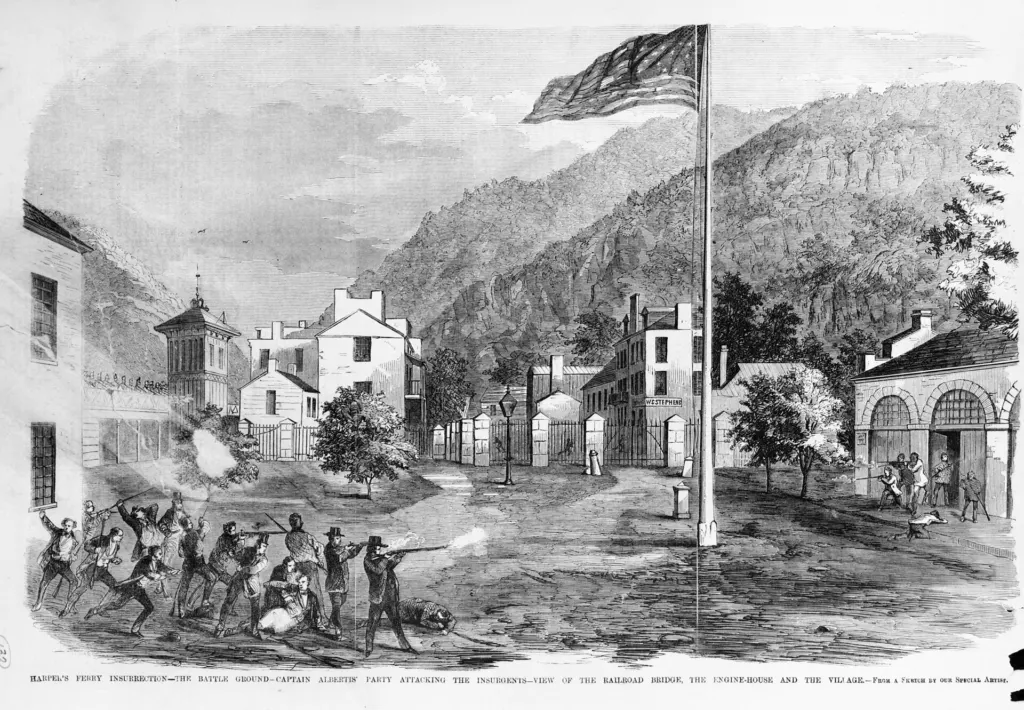
The full timeline, the names of the men who fought with Brown and what happened afterward are in our John Brown's raid guide.
Why has John Brown's Fort moved four times?
John Brown's Fort moved four times because people kept seeing it as either a moneymaker or a shrine. Promoters took it to Chicago in 1891, a journalist brought it back to a farm outside town, Storer College bought it for its campus in 1909, and the National Park Service returned it to Lower Town in 1968.
| Year | What happened to the building |
|---|---|
| 1848 | Built as the armory's fire engine and guard house |
| Oct 1859 | John Brown's last stand; Marines break in on October 18 |
| 1861–1865 | Survives the war as the only armory building left; damaged by souvenir hunters |
| 1891 | Move 1: sold, dismantled and shipped to Chicago, then shown near the World's Columbian Exposition |
| 1894 | Journalist Kate Field campaigns to bring it back; a railroad embankment covers the original site |
| 1895 | Move 2: rebuilt on the Murphy Farm, about three miles from town on a bluff above the Shenandoah |
| 1903 | Storer College starts raising money to buy it |
| 1906 | The Niagara Movement makes a barefoot pilgrimage to it at the Murphy Farm |
| 1909 | Move 3: bought by Storer College and moved to its campus on Camp Hill |
| 1960 | Acquired by the National Park Service |
| 1968 | Move 4: returned to Lower Town, about 150 feet east of its original spot |
Dates follow the NPS John Brown's Fort page. One other NPS page, "A Moving Symbol," dates the Chicago move to 1893, the year the exposition opened; the fort page and Wikipedia's sourced history both say it was sold and shipped in 1891.
Chicago: 11 visitors in ten days
In 1891 the engine house was sold, taken apart and shipped to Chicago, where it was put on display near the World's Columbian Exposition. The venture flopped. According to the NPS, it drew only 11 visitors in ten days, was closed, dismantled again and left on a vacant lot.
The Murphy Farm and Kate Field
In 1894 the Washington journalist Kate Field led a campaign to bring the building home. Alexander Murphy offered five acres of his farm above the Shenandoah, and the Baltimore & Ohio Railroad offered free shipping. The fort was rebuilt there in 1895. Its foundations still mark the spot, and the NPS Murphy-Chambers Farm Trail passes the site near its overlook.
The 1906 pilgrimage
The Murphy Farm is where the Niagara Movement came in August 1906. During its first public meeting in the United States, held at Storer College, members walked in silence to the fort at 6:00am, took off their shoes and socks, and circled it single file while singing. In the NPS's words, the movement "laid the cornerstone of the modern civil rights era." Read the full story in our Storer College guide.
Storer College on Camp Hill
Storer College, the school that grew out of a mission school for formerly enslaved people and was founded in 1867, began raising money for the fort in 1903. In 1909 its president, Henry McDonald, brought the building to the campus on Camp Hill, where it stood for almost six decades.
Back to Lower Town
The National Park Service acquired the fort in 1960, a few years after Storer closed in 1955, and moved it back to Lower Town in 1968. It could not go back on its exact footprint, because the railroad embankment built in 1894 covers the original site. It now stands about 150 feet east of where it stood in 1859.
Where is John Brown's Fort now?
John Brown's Fort stands in Lower Town Harpers Ferry, inside Harpers Ferry National Historical Park, near the corner of Shenandoah and Potomac Streets. From the Lower Town shuttle stop, walk along the Shenandoah Street sidewalks; the NPS says the fort is the last building on the right side of the street.
Wikipedia's sourced history notes that the Baltimore & Ohio placed a white stone obelisk at the original site in 1895, about 150 feet from where the fort stands today. The railroad embankment is the reason the building cannot stand on its first spot.
Getting there is the same as for any Lower Town stop. Park at the Visitor Center at 171 Shoreline Drive and take the park shuttle, because parking in Lower Town is very limited. As of November 2026 the last shuttle back runs at 5:30pm. Our parking, fees and shuttle guide has the details.
Photographing the fort
Stand back on the gravel path so the cupola and all three arched doors fit in the frame. I took the photos of the fort on this site in late morning in September, with the sun on the front.
Can you go inside John Brown's Fort?
Yes. The NPS says John Brown's Fort is open to the public during park hours, and as of November 2026 it is on the park's list of open Lower Town buildings. Pets are not allowed inside, although leashed dogs can wait on the grounds. The NPS describes the fort as accessible to all visitors: a loose gravel path runs from the end of Shenandoah Street to the entrance, and the middle set of doors has the smallest threshold, about three inches.
Is John Brown's Fort open right now?
As of November 2026, John Brown's Fort is open, and so are the nearby John Brown Museum and the Allies for Freedom exhibit. Several other Lower Town buildings are temporarily closed, including the Master Armorer's Quarters, the Civil War Museum, Harper House and the Black Voices exhibit. The park is closed on Thanksgiving, December 25 and January 1. Check the NPS conditions page on the day you go, and see the current conditions panel for weather and river levels.
How much of John Brown's Fort is original?
John Brown's Fort is the genuine 1848 engine house, but after being taken apart and rebuilt several times it is not exactly the building the Marines stormed. Wikipedia's sourced history notes that:
- About 8,000 replacement bricks went into the 1895 rebuilding, replacing bricks taken as souvenirs.
- The doors are not original, and the building was originally painted gray.
- When it was rebuilt on the Storer campus, it was reassembled facing the other way.
- In 1918 Storer College alumni added a memorial tablet to the building.
None of that changes what the building means. For the Niagara Movement in 1906, and for many visitors since, it has been a place to honor the men who died fighting slavery.
What else is near John Brown's Fort?
John Brown's Fort sits at the edge of the old armory grounds, so several related sites are a short walk or drive away:
| Site | What you see | Status (Nov 2026) |
|---|---|---|
| John Brown Museum | NPS exhibits on the raid, in Lower Town | Open |
| Arsenal Square | Outlined foundations of the arsenal buildings Brown came to seize | Outdoor ruins |
| Murphy-Chambers Farm | The fort's 1895–1909 site and the 1906 Niagara Movement pilgrimage; parking on Murphy Road | Trail open |
| Storer College campus, Camp Hill | The fort's home from 1909 to 1968 | Former campus preserved by the park |
| The Point | Where the Potomac and Shenandoah meet, a short walk away | Open |
For the bigger picture, start at the Harpers Ferry history hub, then read our guides to the armory, Storer College and Harpers Ferry in the Civil War. For a full day in town, see the Harpers Ferry itinerary, and if you're staying overnight, see where to stay.