In October 1859, the abolitionist John Brown led a small armed party into Harpers Ferry, then in Virginia, to seize the federal armory and arsenal and strike at slavery. The raid lasted about 36 hours and failed militarily, but it shook the country. This guide follows the raid hour by hour, explains why Brown chose Harpers Ferry, names the men who fought with him, and shows where you can stand on the same ground today. Facts come from the National Park Service, which preserves the raid sites in Harpers Ferry National Historical Park.
Know before you go
| Dates | Night of Oct 16 to morning of Oct 18, 1859 |
| Target | U.S. Armory and Arsenal and the Hall's Island Rifle Works |
| Raiders | Brown and 18 men entered town (NPS timeline) |
| Ended | Marines under Col. Robert E. Lee stormed the engine house, about 7:00am Oct 18 |
| Aftermath | Trial in Charles Town began Oct 27; Brown hanged Dec 2, 1859 |
| See it today | John Brown's Fort and the John Brown Museum, Lower Town — open as of November 2026 (NPS) |
| Anniversary | NPS programs every October around Oct 16–18 |
| Getting there | Park at the Visitor Center and take the shuttle — parking guide |
What was John Brown's raid on Harpers Ferry?
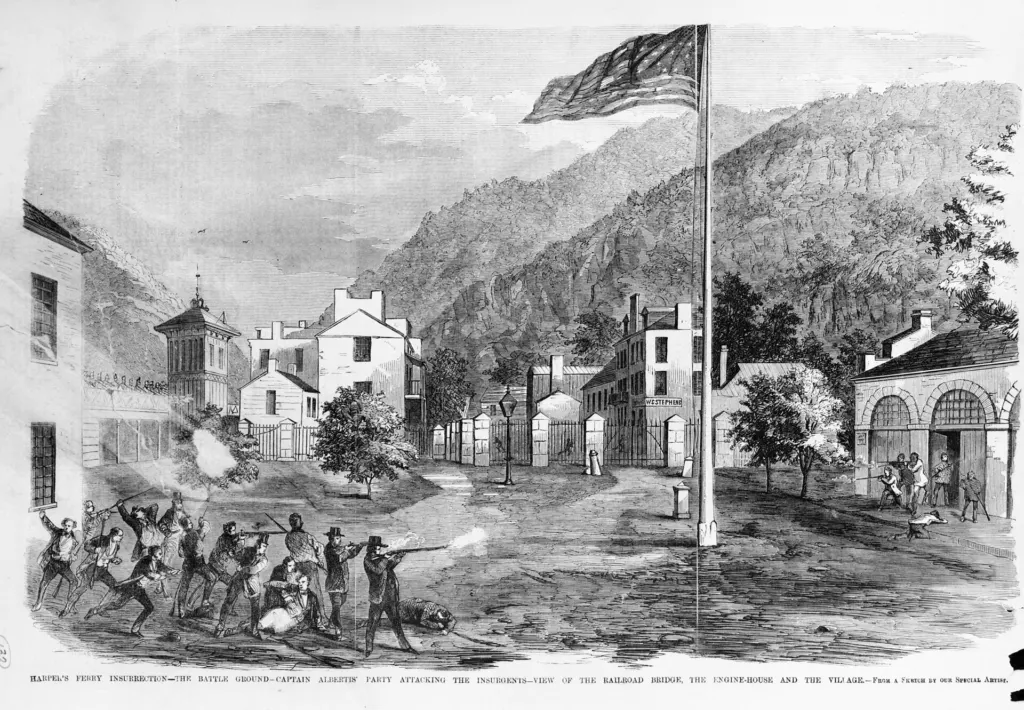
John Brown's raid was an armed attempt to capture the U.S. Armory and Arsenal at Harpers Ferry, free enslaved people in the area and arm them, carried out from the night of October 16 to the morning of October 18, 1859. Brown and his men took the armory, the arsenal, the Rifle Works on Hall's Island and both river bridges within hours. By the next afternoon, local militia had them trapped in the armory's fire engine house, and on the morning of October 18 U.S. Marines broke in and captured Brown.
Brown had prepared for months. He rented the Kennedy Farm on the Maryland side of the Potomac, about five miles from Harpers Ferry, under the alias Isaac Smith, and gathered his men and weapons there. The NPS notes that Harriet Tubman helped recruit for and raise money for the attack.
When did John Brown raid Harpers Ferry? The timeline
The raid began at about 8:00pm on October 16, 1859, and ended at about 7:00am on October 18. This timeline follows the NPS account.
| When | What happened |
|---|---|
| Oct 16, 8:00pm | Brown and 18 of his men advance toward Harpers Ferry |
| Oct 16, 10:00pm | They seize both bridges, the U.S. Armory and Arsenal, and the Rifle Works on Hall's Island |
| About midnight | Raiders take two enslavers, Lewis Washington and John Allstadt, as hostages and free people they held in slavery |
| Oct 17, 1:25am | A B&O passenger train stops at the bridge. Heyward Shepherd, a free Black railroad employee, is shot and mortally wounded while checking on the delay |
| Daybreak | Messengers spread the alarm; Brown takes armory workers hostage as they arrive |
| 7:00am | Townspeople begin firing on the raiders; grocer Thomas Boerly is killed |
| 10:00am | Militia units surround the raiders and cut off escape. Dangerfield Newby is killed. William Thompson is captured under a white flag |
| Noon | Watson Brown and Aaron Stevens are shot carrying a flag of truce |
| 1:00pm | William Leeman is killed trying to escape across the Potomac |
| 2:00pm | Citizens storm the Rifle Works. John Kagi and a formerly enslaved man named Jim are killed; Lewis Leary is mortally wounded. Mayor Fontaine Beckham is shot and killed, and a mob later kills Thompson |
| 3:00pm | Militia free most hostages and force Brown and his remaining men into the engine house |
| After dark | Osborne Anderson and Albert Hazlett escape across the Potomac; Stewart Taylor is killed |
| 11:00pm | Col. Robert E. Lee and 90 U.S. Marines arrive by train from Washington |
| Oct 18, about 7:00am | Brown refuses to surrender to Lt. J.E.B. Stuart. Marines break into the engine house; one Marine is killed. Dauphin Thompson and Jeremiah Anderson are killed; Shields Green and Edwin Coppoc surrender. No hostages are hurt |
| Oct 19 | Brown and the captured raiders are jailed in Charles Town |
| Oct 27 | Brown's trial begins; it lasts five days and ends in a guilty verdict on all charges |
| Nov 2 | Brown is sentenced to hang |
| Dec 2, 1859 | John Brown is hanged in Charles Town |
| Dec 16, 1859 | Shields Green, John Copeland, John Cook and Edwin Coppoc are hanged |
| Mar 16, 1860 | Albert Hazlett and Aaron Stevens are hanged |
Why did John Brown raid Harpers Ferry?
Brown raided Harpers Ferry to strike a blow that would destroy slavery: he meant to seize the federal weapons stored there, free enslaved people, and arm those willing to fight for their freedom. The NPS quotes his own view that "slavery is a state of war." He described the raid as a "trumpet blast" that would open a longer campaign in the mountains of the slave states and make "property in slaves insecure," according to the NPS biography. Frederick Douglass, in an account the park quotes, wrote that the raiders proclaimed emancipation and put weapons into the hands of those "able and willing to fight for their liberty."
Harpers Ferry held a federal armory and arsenal full of weapons, and the Blue Ridge rose right behind the town, which fit Brown's plan for a campaign in the mountains.
The Harpers Ferry Armory guide explains what the armory and arsenal held in 1859.
Who was with John Brown at Harpers Ferry?
The NPS timeline says Brown and 18 of his men advanced on the town, 19 in all. Frederick Douglass, in an account quoted by the NPS, counted those nineteen as fourteen white men and five Black men. Some sources give 21 or 22 instead: the NPS profiles 21 men who joined Brown, including a few who stayed behind in Maryland as a rear guard and never entered Harpers Ferry. The numbers differ because of who is counted, not because the story changes.
Three of Brown's sons took part: Oliver and Watson were killed, and Owen survived. Of all the men who joined Brown, ten were killed or mortally wounded during the raid, seven (including Brown) were later hanged, and five escaped.
Who were the five Black raiders?
The five Black men who fought at Harpers Ferry gave up a great deal to be there, and their names belong in every telling of the raid. From the NPS profiles:
- Dangerfield Newby was born into slavery and later freed. His wife, Harriet, was still enslaved, and the NPS quotes a letter she wrote to him. He was the first raider killed in Harpers Ferry, shot on the morning of October 17.
- Lewis Leary, a free Black man, left a wife and baby to fight against slavery. He was mortally wounded on October 17 while retreating across the Shenandoah and died about ten hours later.
- John Anthony Copeland Jr., a free Black man and a student at Oberlin College in Ohio, was Lewis Leary's nephew. He was captured, tried and hanged in Charles Town on December 16, 1859.
- Shields Green was born into slavery in South Carolina and had found freedom in Canada. He was in the engine house when the Marines broke in, was captured, and was hanged on December 16, 1859.
- Osborne Perry Anderson, a free Black man living in Canada, escaped across the Potomac on the night of October 17 and survived the raid.
Others at Harpers Ferry that day were Black as well: Heyward Shepherd, the free Black railroad worker mortally wounded in the first hours, and Jim, a formerly enslaved man who was killed with John Kagi during the fighting at the Rifle Works.
Who stopped John Brown's raid?
Local militia and townspeople stopped the raid from spreading; U.S. Marines ended it. By 3:00pm on October 17, militia had forced Brown and his remaining men into the armory's fire engine house. That night, Col. Robert E. Lee of the U.S. Army arrived from Washington by train with 90 U.S. Marines. At about 7:00am on October 18, Brown refused to surrender to Lt. J.E.B. Stuart, and a Marine storming party broke into the engine house. Lt. Israel Green beat Brown with his sword. One Marine was killed. None of the hostages were hurt.
How many people died in John Brown's raid?
There isn't one agreed number, and NPS pages themselves count it differently, so we don't give a single figure. What the NPS sources agree on is that ten of Brown's men were killed or mortally wounded during the raid. The differences come from what is counted:
- One NPS article counts 16 people killed in the raid, including those ten raiders. Its timeline names others who died, including Heyward Shepherd, grocer Thomas Boerly, Mayor Fontaine Beckham, a formerly enslaved man named Jim, and one Marine.
- The NPS raider profiles also add up to 16 deaths among Brown's men, but that figure combines the ten killed in the raid with the six raiders who were hanged later.
- Counting John Brown himself, seven members of the raiding party were hanged, so totals that include Brown come out higher again.
If you see "16" or "18" quoted elsewhere, it usually reflects one of these ways of counting.
What happened to John Brown after the raid?
Brown was taken to the jail in Charles Town, Virginia, and his trial began on October 27, 1859. It lasted five days. The jury found him guilty on all charges, including treason against Virginia, and on November 2 he was sentenced to hang. He was executed in Charles Town on December 2, 1859. His last written words, as quoted by the NPS, were:
"I, John Brown, am now quite certain that the crimes of this guilty land will never be purged away but with blood."
His body was taken home to North Elba, New York, for burial. Four of his men were hanged on December 16, 1859, and two more on March 16, 1860.
Our Charles Town guide covers the courthouse where Brown was tried, the execution site and the museum that holds the wagon that carried him to the gallows.
Was John Brown's raid a cause of the Civil War?
The raid did not start the Civil War, but it widened the divide that led to it. The NPS quotes a newspaper of the time saying the raid "advanced the cause of disunion more than any other event," and its account concludes that after the raid, war "seemed inevitable." Less than eighteen months later, on April 18, 1861, U.S. soldiers burned the same armory and arsenal to keep them out of Virginia's hands. The NPS describes Brown's last written words as predicting the war that followed. Historians and visitors still debate how to judge Brown's methods.
What is John Brown's Fort, and why has it moved four times?
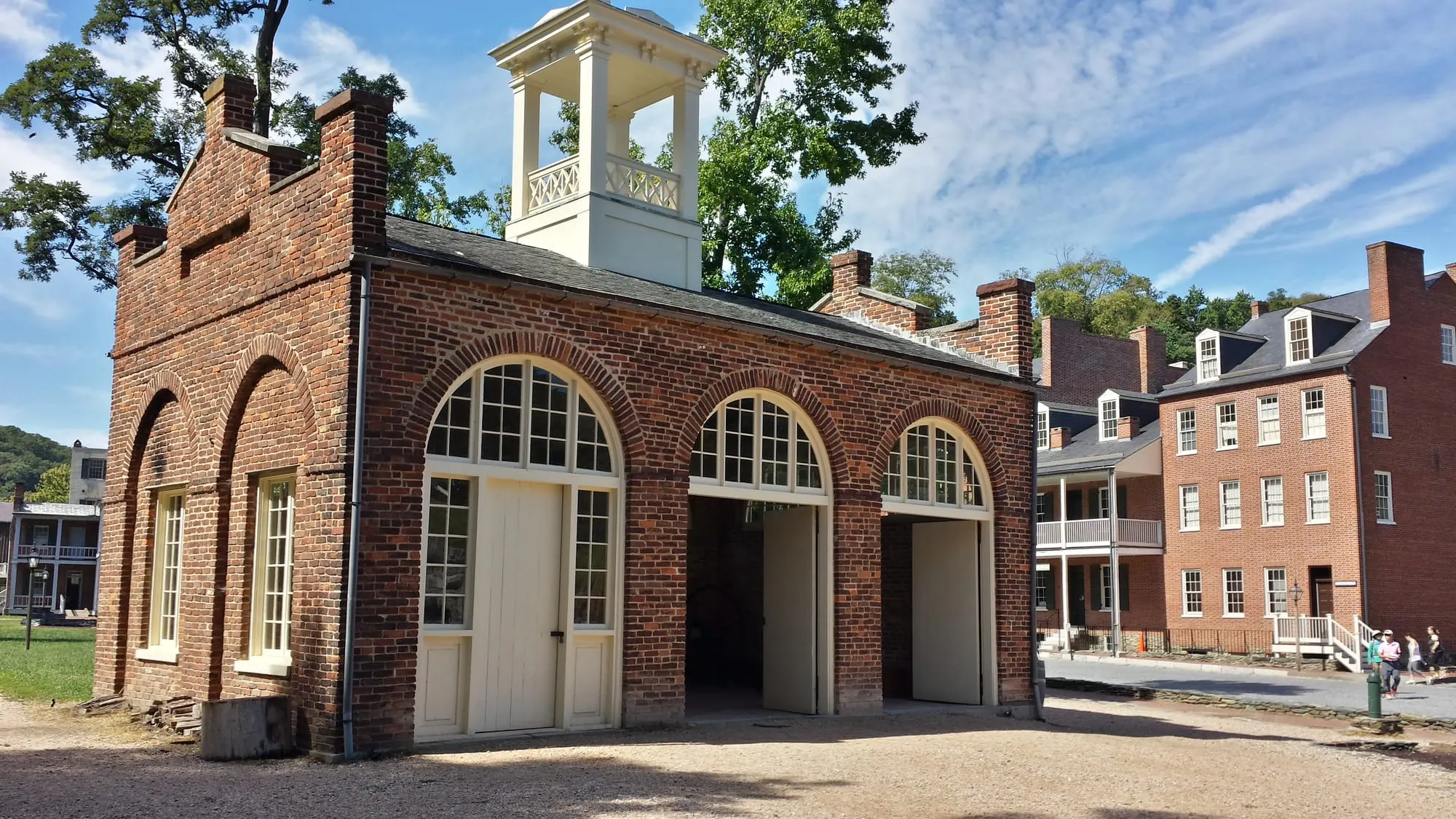
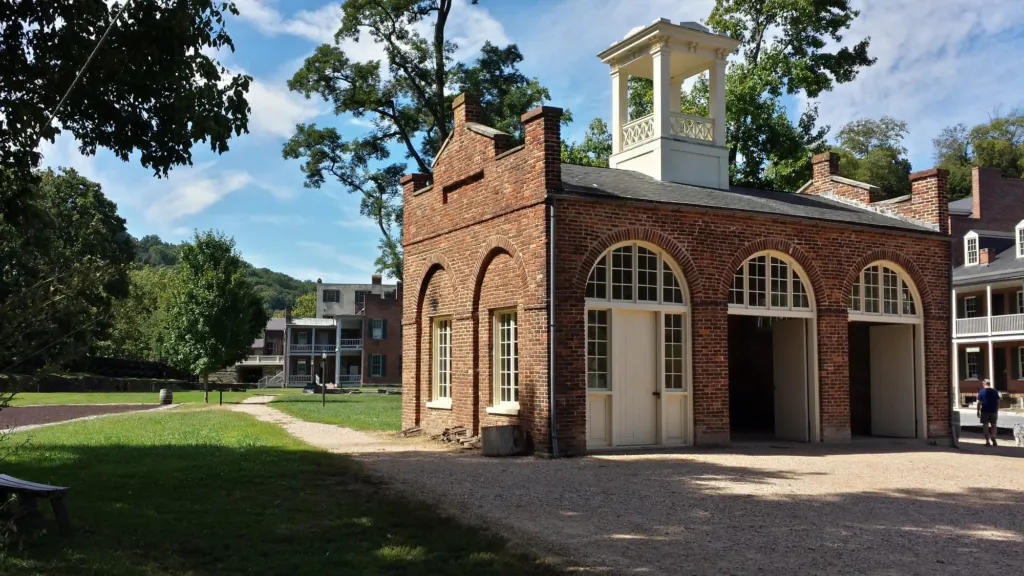
John Brown's Fort is the armory's fire engine and guard house, built in 1848, where Brown and his last men held out until the Marines broke in. It is the only building left from the U.S. Armory. It has been moved four times since the raid:
| Year | Where it went |
|---|---|
| 1891 | Taken apart and shipped to Chicago for the World's Columbian Exposition |
| 1895 | Rebuilt on the Murphy Farm, about three miles from town above the Shenandoah, after journalist Kate Field campaigned to bring it back |
| 1909 | Bought by Storer College and moved to its campus on Camp Hill |
| 1968 | Moved back to Lower Town by the National Park Service |
It could not return to its exact spot because a railroad embankment covered the original site in 1894. It now stands about 150 feet east of where it stood in 1859 (NPS).
More on the building's travels and how to visit it today: John Brown's Fort guide. The fort is stop two on our Lower Town walking tour to Jefferson Rock.
Where can you see John Brown's raid sites today?
You can see most of the raid's key places in and around Lower Town. As of November 2026, the park lists these as open; check the NPS conditions page before you go, because several other Lower Town buildings are temporarily closed.
| Site | What's there | Status (Nov 2026) |
|---|---|---|
| John Brown's Fort | The engine house itself, in Lower Town near Shenandoah and Potomac Streets; a loose gravel path leads to the entrance | Open |
| John Brown Museum | NPS exhibits on the raid, in Lower Town | Open |
| Allies for Freedom | NPS exhibit in Lower Town | Open |
| Virginius & Hall's Islands | Trail to Hall's Island, where the Rifle Works stood | Trail open |
| Murphy-Chambers Farm | The Murphy Farm, the fort's 1895–1909 site, marked by foundations | Trail open |
| Storer College campus (Camp Hill) | The fort's home from 1909 to 1968; the college hosted the 1906 Niagara Movement meeting | Former campus preserved by the park |
The Kennedy Farm, where Brown prepared, is in Maryland about five miles away, and the trial and execution took place in Charles Town, about 8 miles from the park Visitor Center. We haven't verified visiting details for either, so check locally before you go.
Are there John Brown's raid anniversary events?
Yes. The park holds programs every October around the anniversary of the raid on October 16–18. In 2026, for the 167th anniversary, programs included "Proceed to the Ferry" on October 16, a 5-mile processional hike from the Kennedy Farm in Maryland led by Dennis Frye ($200, registration required), and "At All Times Ready" on October 17–18 with the U.S. Marine Corps Historical Company. The NPS usually announces each year's schedule on its news page; check there for October 2027.
What was the Niagara Movement's pilgrimage to John Brown's Fort?
In August 1906, the Niagara Movement, the civil rights organization led by W.E.B. Du Bois, held its first public meeting in the United States at Storer College in Harpers Ferry. At 6:00am on "John Brown's Day," members took off their shoes and socks and walked in silence to the fort, then marched single file around it singing "The Battle Hymn of the Republic" and "John Brown's Body." Du Bois's "Address to the Country" was read on August 19, the final day. Most of the movement's members later helped form the NAACP. Twenty-five years earlier, in 1881, Frederick Douglass had given a speech on John Brown at the same college.
For the wider story of the town, from the armory to the Civil War and Storer College, see the Harpers Ferry history hub. To plan a visit, start with parking, fees and the shuttle and where to stay.
See our Storer College and Niagara Movement guide for the campus today.