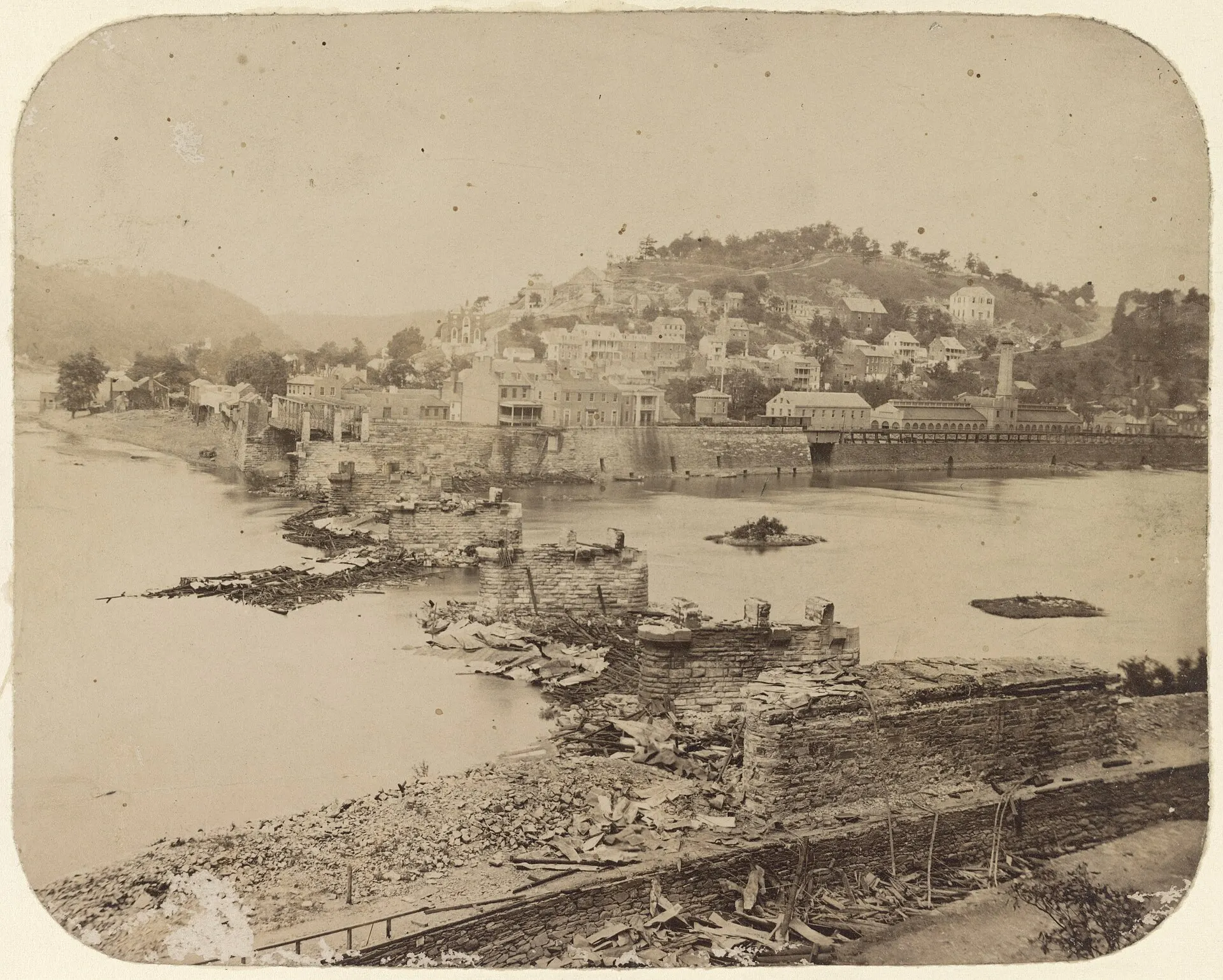
For sixty years, Harpers Ferry was a federal factory town. The U.S. Armory and Arsenal filled the riverbank below the town with workshops, canals and water-powered machinery, and it made the weapons that drew Meriwether Lewis in 1803, John Brown in 1859 and both armies in the Civil War. This guide covers why the armory was built here, what it made, how it was destroyed in 1861, and the little that remains to see. The facts come mainly from the National Park Service, which preserves the armory site as part of Harpers Ferry National Historical Park.
Know before you go
| Founded | Authorized 1794; land bought 1796; construction began 1799 — NPS |
| Output | More than 600,000 muskets, rifles and pistols, 1801–1861 |
| Workforce | About 25 men in 1802; about 400 by 1859 |
| Famous products | Model 1803 rifle, Hall breech-loading rifle, Model 1841 rifle |
| Destroyed | April 18, 1861, by retreating U.S. soldiers; remaining buildings burned later in 1861 |
| What survives | John Brown's Fort (1848 engine house); arsenal foundations in Arsenal Square |
| Open (Nov 2026) | John Brown's Fort, Industry Museum, Meriwether Lewis exhibit — NPS conditions |
| Closed (Nov 2026) | Master Armorer's Quarters, temporarily |
When was the Harpers Ferry Armory founded?
The Harpers Ferry Armory was founded in the 1790s and built from 1799. In 1794 Congress passed a bill "for the erecting and repairing of Arsenals and Magazines." Springfield, Massachusetts, became the first national armory, and President George Washington picked Harpers Ferry, then in Virginia, as the second. In 1796 the government bought a 125-acre tract between the Potomac and Shenandoah from Robert Harper's heirs, and construction of the "United States Armory and Arsenal at Harpers Ferry" began in 1799. The NPS says full-scale production began in 1802, with about 25 workers.
Why did George Washington choose Harpers Ferry for an armory?
George Washington knew Harpers Ferry well before he chose it. In the summer of 1785, as president of the Patowmack Company, which was building river improvements on the Potomac, he spent two days inspecting the river at Harpers Ferry. In 1794, the NPS says, Washington "used his familiarity with Harpers Ferry to champion the site." Wikipedia's sourced history adds that he preferred an inland site that would be easier to defend, and that his friends' interest in the Potomac navigation scheme also played a part.
Harpers Ferry Armory timeline
The armory's story runs from George Washington's choice of the site to its destruction in the first days of the Civil War. Dates come from the NPS unless marked as Wikipedia.
| Year | What happened |
|---|---|
| 1785 | Washington inspects the river at Harpers Ferry for the Patowmack Company |
| 1794 | Congress authorizes national armories; Washington champions Harpers Ferry |
| 1796 | The government buys 125 acres from Robert Harper's heirs |
| 1799 | Construction of the armory and arsenal begins |
| 1802 | Full-scale arms production begins, with about 25 workers |
| 1803 | Meriwether Lewis outfits the Lewis and Clark Expedition at the armory; the Model 1803 rifle is adopted (Wikipedia) |
| By 1810 | Output averages about 10,000 arms a year |
| 1819 | John H. Hall signs a contract for 1,000 breech-loading rifles |
| 1820–1840 | Hall's Rifle Works pioneers interchangeable-parts manufacturing |
| 1833–1834 | The C&O Canal and the B&O Railroad reach Harpers Ferry |
| 1845–1854 | Rebuilding: seven new workshops, 121 new machines and new turbines |
| 1848 | The fire engine and guard house, later John Brown's Fort, is built |
| Oct 1859 | John Brown's raiders seize the armory and arsenal; about 400 men work there that year |
| Apr 18, 1861 | U.S. soldiers set fire to the armory and arsenal |
| Jun 1861 | Confederates burn the remaining armory buildings and Hall's Rifle Works |
What was made at the Harpers Ferry Armory?
The Harpers Ferry Armory made military muskets and rifles from the start and added pistols after 1805; the NPS counts more than 600,000 firearms made between 1801 and 1861. By 1810 output averaged about 10,000 arms a year. The armory struggled with a chronic shortage of waterpower and charges of mismanagement, which led to a full rebuilding between 1845 and 1854 into a set of brick, cast-iron-framed shops known as the "U.S. Musket Factory."
| Weapon | Made at Harpers Ferry | Why it matters |
|---|---|---|
| Model 1803 rifle | First run of about 4,000 finished in 1807; second run to 1819 | First standard rifle made by a U.S. armory (.54 caliber) |
| Hall rifle (M1819) | 1820s–1840s, at Hall's Rifle Works | Breech-loader made with precision machinery for interchangeable parts |
| Model 1841 "Mississippi" rifle | About 70,000 made by Harpers Ferry and contractors, 1846–1855 | Named for Jefferson Davis's Mississippi regiment in the Mexican-American War |
Production figures for the three models come from Wikipedia; the NPS gives the armory totals.
The Model 1803 rifle
The Model 1803 was the first standard rifle, as opposed to a smoothbore musket, made by an American armory. The War Department ordered it on May 25, 1803, and it fired a .54-caliber ball. Harpers Ferry finished the first order of about 4,000 rifles in 1807 and made more in a second production run that ended in 1819. Men of the 1st U.S. Regiment of Rifles carried it in the War of 1812.
Did Lewis and Clark carry rifles from Harpers Ferry?
Yes. Meriwether Lewis arrived at the Harpers Ferry Armory on March 16, 1803, with a letter from Secretary of War Henry Dearborn asking the superintendent, Joseph Perkins, to fill his order "with the least possible delay." According to the NPS, the armory supplied:
- 15 rifles and 15 powder horns
- 30 bullet molds and 30 ball screws
- extra rifle and musket locks and gunsmith's repair tools
- several dozen tomahawks and 24 large knives
- a collapsible iron boat frame, which Lewis called "The Experiment," designed to be covered with hide
Lewis left on April 18, 1803, after just over a month, and came back about 11 weeks later to collect the order. Which rifles he carried is still debated. Some historians say they were early Model 1803s; others argue they were modified rifles from the 1790s. The NPS exhibit "Meriwether Lewis at Harpers Ferry," on Potomac Street, is open as of November 2026.
The Hall rifle and interchangeable parts
John H. Hall patented a breech-loading rifle in 1811 and in 1819 signed a War Department contract for 1,000 of them. He set up in an old armory sawmill on the Shenandoah, on what the NPS calls Lower Hall Island, and the site became Hall's Rifle Works. Hall spent years building precision machinery, including a straight-cutting machine the NPS calls the forerunner of the milling machine, and in 1822 he wrote that he had succeeded in "establishing methods for fabricating arms exactly alike." The NPS says he "pioneered interchangeable firearms manufacture" at the Rifle Works between 1820 and 1840, laying a foundation for the American factory system. Wikipedia counts about 23,500 Hall rifles, and says the Harpers Ferry production line closed in 1844.
What happened to the Harpers Ferry Armory in 1861?
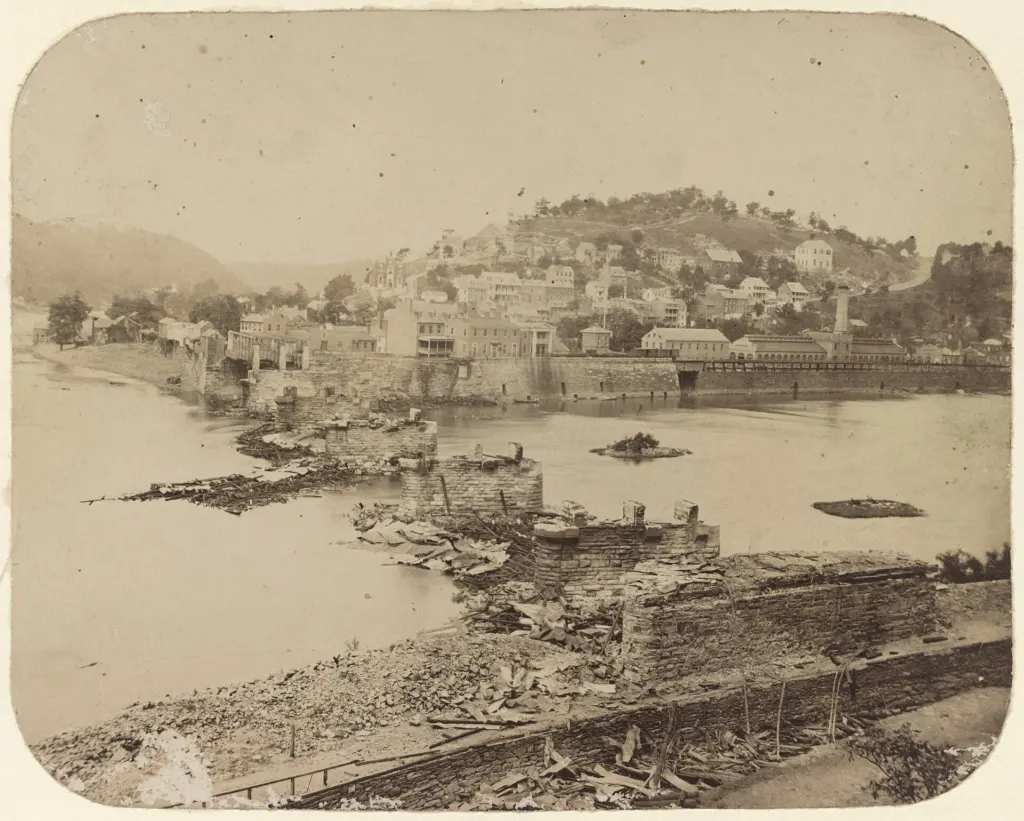
U.S. soldiers set fire to the Harpers Ferry Armory and Arsenal on April 18, 1861, the day after Virginia passed its ordinance of secession. Lt. Roger Jones had 50 regulars and 15 volunteers to hold the post; about 360 Virginia militia were on the way from Charles Town. Jones set the buildings alight and retreated across the Potomac. The fire in the two arsenal buildings destroyed about 15,000 weapons, the stock left after most arms had been sent to Southern states before the war.
The armory machinery fared better. Wikipedia's sourced account says townspeople put out the fires in the shops quickly enough to save most of it, and the NPS says Confederate forces shipped the machinery and tools south to Richmond and Fayetteville, North Carolina, over the following weeks. When the Confederates withdrew, they burned the armory buildings on June 14, 1861, and raiders burned Hall's Rifle Works on June 28. The U.S. government never re-established the armory. Read more about the war years in our Harpers Ferry Civil War guide.
What remains of the Harpers Ferry Armory today?
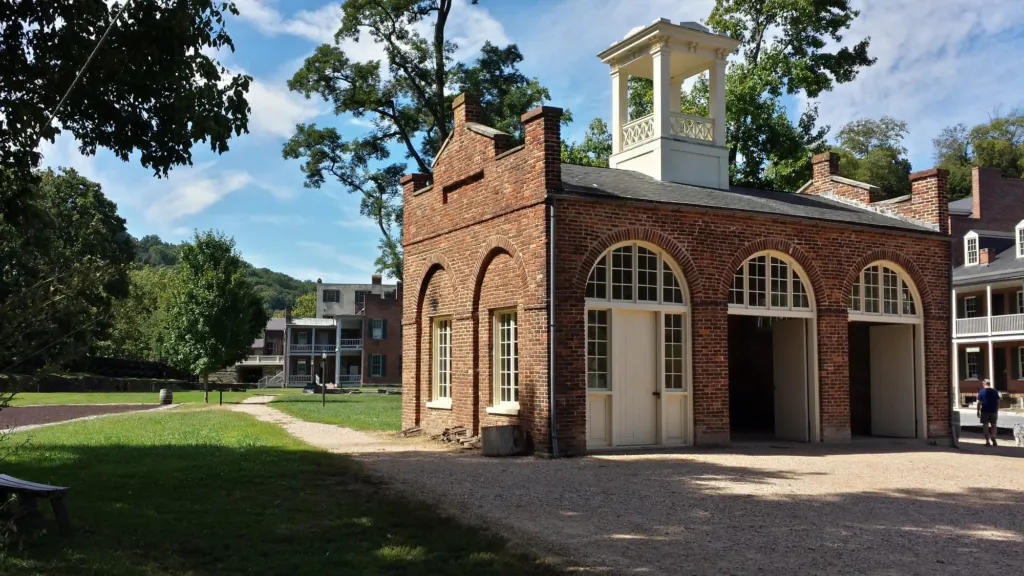
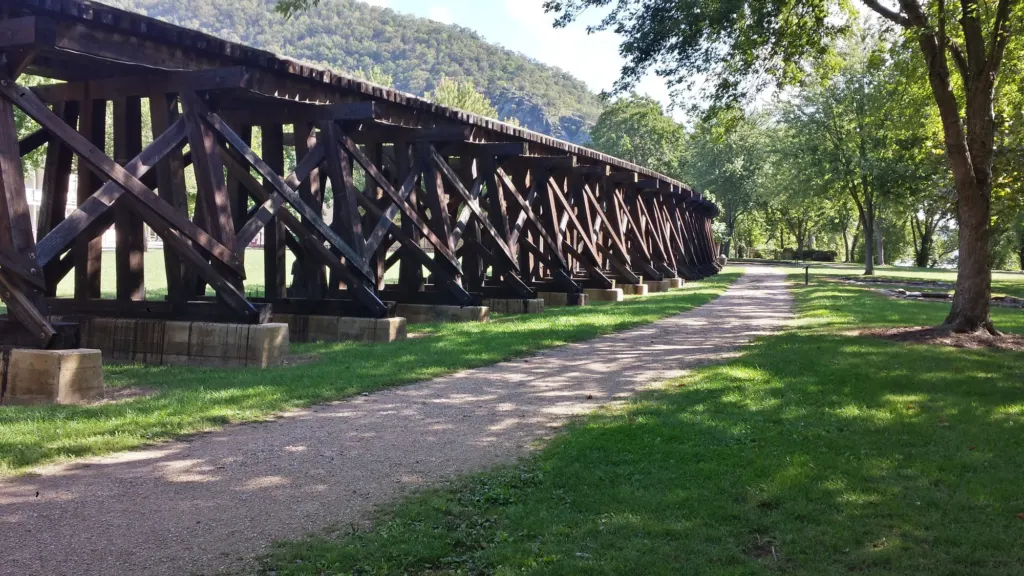
Very little of the Harpers Ferry Armory survives above ground: the only remaining armory building is the 1848 fire engine and guard house now called John Brown's Fort, and railroad embankments cover almost all of the old armory grounds. Here is what you can see:
| Site | What's there | Status (Nov 2026) |
|---|---|---|
| John Brown's Fort | The armory's 1848 engine house, moved back to Lower Town in 1968 | Open |
| Arsenal Square | Outlined foundations of the arsenal buildings, built about two feet above the original walls; one arsenal stood from 1806 to 1861 | Outdoor ruins |
| Armory (Musket Factory) grounds | Buried under railroad embankments; the 1848 smith and forging shop, the largest armory workshop at 280 by 36 feet, lies beneath | Not visible |
| Hall's Island | Site of Hall's Rifle Works, on the Virginius and Hall's Islands trail (up to 2 miles, easy) | Trail open |
| Industry Museum | NPS exhibits on Virginius Island's factories and how weapons were made by machine | Open |
| Meriwether Lewis at Harpers Ferry | NPS exhibit on Lewis's 1803 visit, on Potomac Street | Open |
| Master Armorer's Quarters | NPS exhibit building in Lower Town | Temporarily closed |
| Anthony Hall and Lockwood House | 1848 homes of the armory superintendent and paymaster on Camp Hill, later part of Storer College | View from outside |
When NPS archaeologists uncovered the arsenal foundations, close to 100 years after the Civil War, they found thousands of burned weapon fragments, including melted barrels, bayonets and lock plates.
How do you visit the armory sites?
The armory sites are all in or near Lower Town, inside Harpers Ferry National Historical Park. Park at the Visitor Center at 171 Shoreline Drive and take the shuttle, because Lower Town parking is very limited; the park entrance fee applies. As of November 2026, Lower Town buildings are listed as open 9am to 5pm, though several are temporarily closed, so check the NPS conditions page first. See our parking, fees and shuttle guide, the Jefferson Rock and Lower Town walking guide and where to stay.
For the rest of the story, start at the Harpers Ferry history hub, then read about John Brown's raid, which targeted the armory's weapons in 1859.